Package to Convert
The Cover Is the Ad: Designing a Cover That Sells
Roughly half of indie sales, judged in under two seconds. Fit your genre's conventions first, then differentiate within them — and test with real readers before you commit.
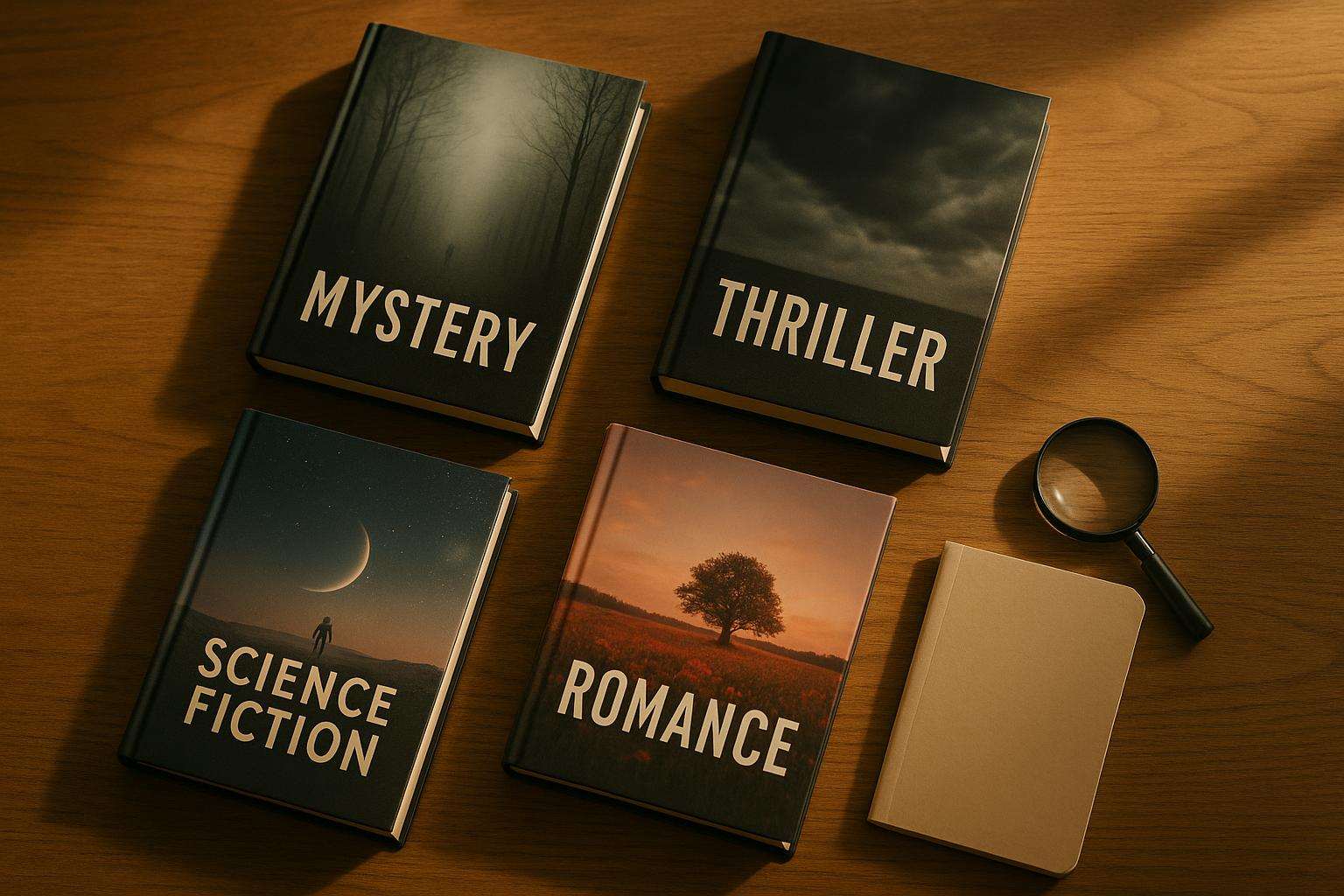
The cover accounts for roughly half of an indie book's total sales performance. Not half of its impressions — half of its sales. That figure comes from Kindlepreneur's analysis of more than 20,000 self-published books, and it reorders every priority a careful writer brings to launch day: you can write the better book and lose to the worse one whose cover did its job, because the cover is the first thing almost every reader sees and the thing most of them never get past. Demand by Design treats the cover the way an ad agency treats a billboard seen from a moving car — one job, almost no time, do it or get scrolled past.
The window is short. A reader browsing Amazon search results spends approximately 1.7 seconds looking at any given cover before moving on. In that flicker, the cover has to communicate three things: what genre this is, what the title is, and who wrote it. Not the plot. Not the theme. Not the years of labor behind the prose. Genre, title, author — at thumbnail size, in under two seconds. A cover that fails any one of the three has failed all three.
The bottom line: The cover accounts for up to half of an indie book's total sales performance, judged in approximately 1.7 seconds at thumbnail size. Fit the conventions of your exact subgenre first — matching roughly 70% of the shared visual cues of the top-20 covers in your category — then differentiate in one controlled place. Genre confusion is the single most expensive cover mistake; in the thriller category, wrong-convention covers show roughly a 64% reduction in click-through among core readers.
What does a cover actually have to do in under two seconds?
The governing principle is not "stand out." It is fit in, then stand out — a phrase that appears in virtually every professional analysis of what makes a commercial cover work, because it describes exactly how a reader's eye sorts a crowded search page. The cover must first look unmistakably like the category the reader came for — so they recognize it as a candidate at all — and only then differentiate in the one or two places that make them choose yours over the others that also fit the family.
The data runs one direction. Covers matched to their genre's established conventions average 37% higher click-through and 23% better conversion than covers that attempt creative differentiation, according to CoverRater's analysis of more than 50,000 book covers. In the thriller category specifically, a cover that deviates from the established visual code shows roughly a 64% reduction in click-through among core readers. That is not a modest disadvantage. It is the difference between being found and being invisible.
The mechanism is recognition. High-volume genre readers — the people who buy forty books a year and decide in seconds — are not looking for something unlike anything they have seen. They want a cover that looks almost exactly like the last book in the genre they loved, because that resemblance is the promise this one delivers the same feeling. Kindlepreneur's 20,000-book analysis put it plainly: "Creativity kills covers." The biggest mistake authors make is straining to look different from the crowd when the crowd is the entire signal the reader uses to find them.
The "stand out" half is real, but it occupies a narrow band. Match the genre on the load-bearing signals — art style, palette family, type treatment, composition — and differentiate on one controlled variable: a distinctive accent color within the genre-acceptable range, a sharper title lockup, or a single hero element no direct competitor is using. The practical audit: collect the current top-20 covers in your exact subcategory, extract the three or four visual moves they share, replicate those, and add exactly one differentiator. If your draft shares fewer than roughly 70% of those shared cues, you have a genre-confusion problem, not a bold cover.
How do subgenre conventions differ — and why does subgenre matter more than genre?
"Thriller" is not a shelf; it is a warehouse. Domestic noir, psychological thriller, police procedural, Nordic noir, and action-adventure each have their own distinct visual grammar, and a cover that signals "thriller" but not "domestic thriller" still misfires. Micro-genre visual coding — hitting the right subgenre cues, not just the broad genre — is associated with 43% higher sales within a subcategory versus generalized genre design, per data cited by Pandamonium Publishing drawing on Amazon category information. The same granularity applies everywhere: romantasy, dark romance, and historical romance are three different visual systems that happen to share a genre label.
The table below maps the primary visual conventions across the largest indie-publishing categories, drawn from Creativindie's 2026 genre design guides, the NINC 2024 romance cover trends report, and Makemybookcover's analysis of the Amazon thriller Top 100:
| Subgenre | Dominant palette | Typography direction | Key focal element |
|---|---|---|---|
| Psychological thriller | True black; blood red #8B0000; steel blue | Heavy condensed sans (Bebas Neue); title fills 30–50% of canvas | Distorted face, fractured mirror, water reflection |
| Domestic noir | Muted navy #1B2438; slate; small warm accent | Heavy condensed sans; off-center text placement | House, window, woman walking away |
| Romantasy | Ruby, emerald, deep gold; jewel tones; gold foil on print | Ornate serif + accent script (Cinzel or Trajan Pro) | Floral-and-weapon border; illustrated figure; crown motifs |
| Dark romance | Black; blood red; burnished gold; deep plum | Sharp serif or bold condensed; hand-lettered accents | Partial figures (hands, jawlines); thorned roses; daggers |
| Epic fantasy | Deep navy; forest green; antique gold | Cinzel or Trajan Pro at large scale | Panoramic heroic landscape; lone silhouette |
| Sci-fi (cyberpunk) | Deep space blue; neon cyan; royal purple | Eurostile or Bank Gothic; HUD-adjacent lettering | Night city; rain reflection; lone figure |
| Business / nonfiction | Navy; corporate blue; black + gold | Bold sans-serif (Futura, Montserrat); type-dominant | Typography IS the cover; minimal imagery |
| Cozy mystery | Warm bright multi-accent; large yellow or teal | Friendly chunky serif | Illustrated home scene, whimsical animal, hand-drawn scene |
Cozy mystery deserves a separate note. It has a highly formalized hand-illustrated visual grammar built up over a decade, and cozy readers detect AI-generation tells — hand anatomy errors, face drift across images, hallucinated background text, warped animal anatomy — faster than any other genre audience. If you are writing cozy, that subgenre's visual conventions are both precise and policed by its readers.
What are the craft rules that keep a cover from looking homemade?
Three decisions carry most of a cover's signal, and each has a discipline that separates professional from amateur. Hold to all three and a cover reads as competent before a reader can say why; violate any one and it reads as self-published in the costly sense.
Typography — at most two fonts, the title legible at thumbnail. Use one font for the title and one for the author name, with an optional subordinate font for a subtitle, and stop there. A third typeface starts to read as a ransom note. Never use a script or thin decorative font as the primary title — it dissolves to a smear below about 100 pixels, exactly where the cover has to work. Amazon KDP's cover image guidelines require JPEG format, sRGB color space (CMYK renders with dull, inaccurate color and is unsupported), a recommended design size of 2,560 × 1,600 pixels, and 300 DPI. For an unknown author, the title runs close to the full cover width and the author name sits at roughly half its size. A famous name inverts that, because the name is the selling point. Titles in thriller and nonfiction now regularly occupy 30–50% of the cover canvas — type-dominant design is the dominant 2025–2026 trend per Damonza's analysis, with some covers pushing type to 70–80% of the canvas.
Color — three dominant colors at most, verified against genre convention. Color does more work than any other single element: research cited by Spines suggests roughly 90% of snap product judgments are made within 90 seconds and are driven primarily by color. Hold to no more than three dominant colors, let the genre constrain the palette, and apply the 60/30/10 ratio — approximately 60–70% of the cover to the primary genre-signaling color, 20–30% to a neutral, and 10% to the accent. Multiple competing visual elements reduce conversions by approximately 40%; in one documented case, decluttering a romance cover and simplifying its palette increased sales by 75%, per Authors on Mission's 2024 cover psychology report.
One hero element, type designed first. A cover holds one focal point. One symbolic object — a crown, a dagger, a single figure, an abstract mark — outperforms a composition packed with characters and plot moments, because the reader has under two seconds and a cluttered cover spends that time confusing them. Design the type before you choose the image so the title never fights the picture for the same space. Then run the thumbnail test: shrink the finished cover to 160 pixels wide and confirm the genre, the title, and the mood still read instantly. Among Amazon bestsellers, 92% have titles readable at thumbnail size; among books with fewer than 100 reviews, only 34% pass that test, per BookAutoAI's analysis of KDP cover data.
When should you commission a designer, and what does it cost?
Professionally designed covers sell an estimated 2.5 times more copies than DIY alternatives on average, with return on investment running 200–400% in romance and thriller specifically, per CoverRater's 2025 dataset. Whether that premium is worth the investment depends on your genre, your budget, and how much existing traffic will flow through the cover. The cover's job is conversion — if nobody is finding the book yet, a better cover does almost nothing. Fix discoverability first, then fix conversion.
Current 2026 market rates for indie book covers, from Makemybookcover and Creativindie's published ranges:
| Cover type | Approx. price (2026) | Typical turnaround |
|---|---|---|
| Premade cover | $50–$350 | Hours to 1 day |
| Custom indie designer | $300–$700 | 2–4 weeks |
| Boutique designer | $700–$1,500 | 4–12+ weeks |
| Cozy illustrated commission | $400–$1,500 | 4–10 weeks |
| Top-tier psychological thriller | $2,000–$5,000+ | Months |
When briefing a designer, provide exactly two or three on-trend top-100 covers from your exact subgenre and nothing else. Providing plot summaries, mood boards, or AI-generated mockups is a documented pattern that stifles designer judgment and produces what the industry calls "frankencovers" — covers that authors become attached to but readers do not click. Lock the full visual system — typeface, palette, layout grid, art style — before you finalize Book 1 of any series, because changing the typeface between volumes is the single most damaging error in series cover design, fracturing brand recognition faster than almost any other change and making your own sequel invisible to your own readers.
How do you test a cover with real readers before you commit?
The most reliable thing known about cover decisions is that the author is a poor predictor of which cover sells. The move is not to decide — it is to test, with the only people whose opinion predicts sales: genre readers, not friends, not family, not your email list. Friends vote with social consideration; your email list is biased by familiarity with you. Both give you the wrong signal consistently, and documented cases show authors being repeatedly "stunned" that readers preferred the cover the author liked least.
The standard panel-testing method is PickFu, which delivers genre-targeted reader responses — typically 30–50 respondents — often within hours. A book cover comparison template runs approximately $60 for 30 genre-matched respondents as of 2026. Two rules make testing useful: first, ask a purchase-intent question — "Which cover would make you click to buy this book on Amazon?" — rather than an aesthetic preference question, which tests taste rather than buying behavior; second, read the written comments, not just the vote percentages, because the qualitative explanations reveal why a design wins or loses, which is the actionable signal. A near-even split is not a winner — it is a sign to add a third option or a larger sample.
For higher-stakes decisions, live-traffic testing via BookBub Ads or Facebook Ads at roughly $25–$50 per variant provides behavioral confirmation a panel poll cannot. In a documented case, legal thriller author Melissa F. Miller ran five rounds of CPM-equalized BookBub Ads cover testing — approximately $320 total across all rounds — and identified a typography-dominant cover that achieved a 5.2% click-through rate against the original's 2.85%, resulting in 40% more free downloads of her series opener. That is a real mechanism: a better-signaling cover converts the traffic you already have more effectively. It does not create traffic from nothing.
One calibration note every time cover redesign case studies appear: a six-times or ten-times sales lift from a cover swap happens to a book that already had traffic and a poorly signaling cover — the redesign unlocked demand that was arriving and bouncing, not demand that was absent. Treat the documented cases as proof of the mechanism, never as a promised multiple for any specific book in any specific position. The cover earns the click. What you do with the click — the description, the Look Inside, the pricing — is a separate set of decisions, and all of them depend on having the click in the first place.
Frequently asked
How much of an indie book's total sales does the cover actually influence?
Kindlepreneur's analysis of more than 20,000 self-published book covers found that a well-executed, on-trend cover can account for up to half of an indie book's total sales performance — not half of impressions, half of actual sales. A Pandamonium Publishing study found that 57% of readers report buying a book based solely on the cover, while 79% say cover design plays a decisive role in whether they click at all. Books with strong micro-genre visual coding achieve 43% higher sales within their subcategory than books with generalized genre design. These figures reflect covers that do their job; the inverse also holds — covers that signal the wrong genre actively suppress sales, reducing click-through by roughly 64% in the thriller category, per CoverRater's 50,000-cover dataset.
What does 'fit in, then stand out' mean in practice for a book cover?
"Fit in, then stand out" describes the priority order a successful commercial cover follows: genre membership comes first; differentiation comes second, in a smaller amount. A working proportion is roughly four-fifths convention and one-fifth difference. You match the load-bearing visual signals of your exact subgenre — the palette family, type treatment, art style, and focal element type — and then break exactly one rule on purpose, usually through an accent color within the genre-acceptable range, a sharper title lockup, or a single hero element no direct competitor is using. The practical audit: collect the top-20 covers in your exact subgenre, extract the three or four moves they share, replicate those, and add exactly one differentiator. If your draft shares fewer than roughly 70% of those shared cues, you have a genre-confusion problem rather than a bold design. Attempting visual differentiation outside subgenre conventions in high-volume categories like romance and thriller is almost always costly to click-through rates.
What is the thumbnail test, and how do I pass it?
Amazon displays ebook covers at approximately 100–180 pixels tall on most device screens; the standard professional test is to shrink your finished cover to 160 pixels wide — roughly the size at which it competes in a phone search result — and confirm that the genre mood, the title, and the emotional promise still read instantly. Among Amazon bestsellers, 92% have titles readable at thumbnail size; among books with fewer than 100 reviews, only 34% pass that test, per BookAutoAI's analysis. Two elements most often fail at thumbnail scale: script or decorative title fonts, which dissolve into illegible marks below about 100 pixels; and compositions with multiple competing focal elements, which become visual noise at small sizes. The goal is not letter-by-letter title legibility — readers may not consciously parse every word at 160 pixels — but confirming that the genre signal and emotional mood are unmistakable before the reader has processed a single word.
How many fonts and colors should a book cover use?
The industry-standard rules are two fonts maximum — one for the title, one for the author name, with an optional clearly subordinate third font for a subtitle or series designation — and three dominant colors maximum for dark genre fiction. The two-font rule is a hard constraint across virtually every professional cover design guide; a third typeface typically reads as amateur regardless of how tastefully chosen. The color rule is equally firm in dark-palette genres: one dominant dark base (black, navy, charcoal) plus one accent plus one contrast tone for the title. A useful allocation framework is the 60/30/10 ratio — approximately 60–70% of the cover to the primary genre-signaling color, 20–30% to a neutral, and 10% to the accent. Multiple competing colors scatter the eye and read as self-published in the damaging sense; in one documented case, decluttering a romance cover by simplifying its color palette increased sales by 75%, per Authors on Mission's 2024 analysis.
Should I hire a professional designer or design my cover myself?
Professionally designed covers sell an estimated 2.5 times more copies than DIY alternatives on average, with professional cover return on investment running 200–400% in romance and thriller specifically, per CoverRater's 2025 trend data. Whether that premium is worth the investment depends on your genre, your budget, and how much existing traffic will flow through the cover. Current 2026 market rates run from $50–$350 for a premade cover — a finished design you personalize with your title and name — to $300–$700 for a custom indie designer, $700–$1,500 for a boutique firm, and $2,000–$5,000+ for top-tier psychological thriller commissions. The lower-cost path works when you brief correctly: provide exactly two or three on-trend top-100 covers from your exact subgenre and nothing else. DIY covers built on personal taste rather than a thorough genre audit consistently read as out of place on the shelf, because genre conventions must be studied before they can be matched.
How do I test a book cover with real readers before I publish?
The standard method is a panel poll via PickFu, which delivers genre-targeted reader responses — typically 30–50 respondents — within hours. A book cover comparison template costs approximately $60 for 30 genre-matched respondents as of 2026. Two rules govern useful testing: first, ask a purchase-intent question — "Which cover would make you click to buy this book on Amazon?" — rather than an aesthetic preference question; second, read the qualitative comments, not just the vote percentages, because the written explanations reveal why a design wins or loses. For higher-stakes decisions, live-traffic testing via BookBub Ads or Facebook Ads at roughly $25–$50 per variant provides behavioral confirmation a panel poll cannot. In a documented case, legal thriller author Melissa F. Miller ran five rounds of CPM-equalized BookBub Ads testing at approximately $320 total and identified a typography-dominant cover that achieved a 5.2% click-through rate against the original's 2.85%, resulting in 40% more free downloads of her series opener.
What is the most expensive cover mistake an indie author can make?
The most expensive mistake is a cover that signals the wrong genre or the wrong subgenre — and it is expensive not because of what the cover costs to produce but because of the sales it silently prevents. A reader browsing Amazon search results spends approximately 1.7 seconds looking at any given cover; in that window, the cover sorts into the right shelf or gets scrolled past. Wrong-genre covers cost you every qualified reader who arrives and bounces without clicking, and they draw wrong-fit readers who leave reviews noting the book was not what the cover promised — which then discourages the right readers. The penalty is measurable: in the thriller category, covers that deviate from the established visual code show roughly a 64% reduction in click-through among core genre readers, per CoverRater's analysis of 50,000+ covers. A beautiful cover that signals the wrong shelf is not a bold artistic choice — it is a commercial liability.