Craft That Sells
The Editing Pipeline: What Stages You Need and What to Spend
Editing is a sequence, not one pass. Developmental to proofread — and the $250–$999 spend range that correlates with rising income.
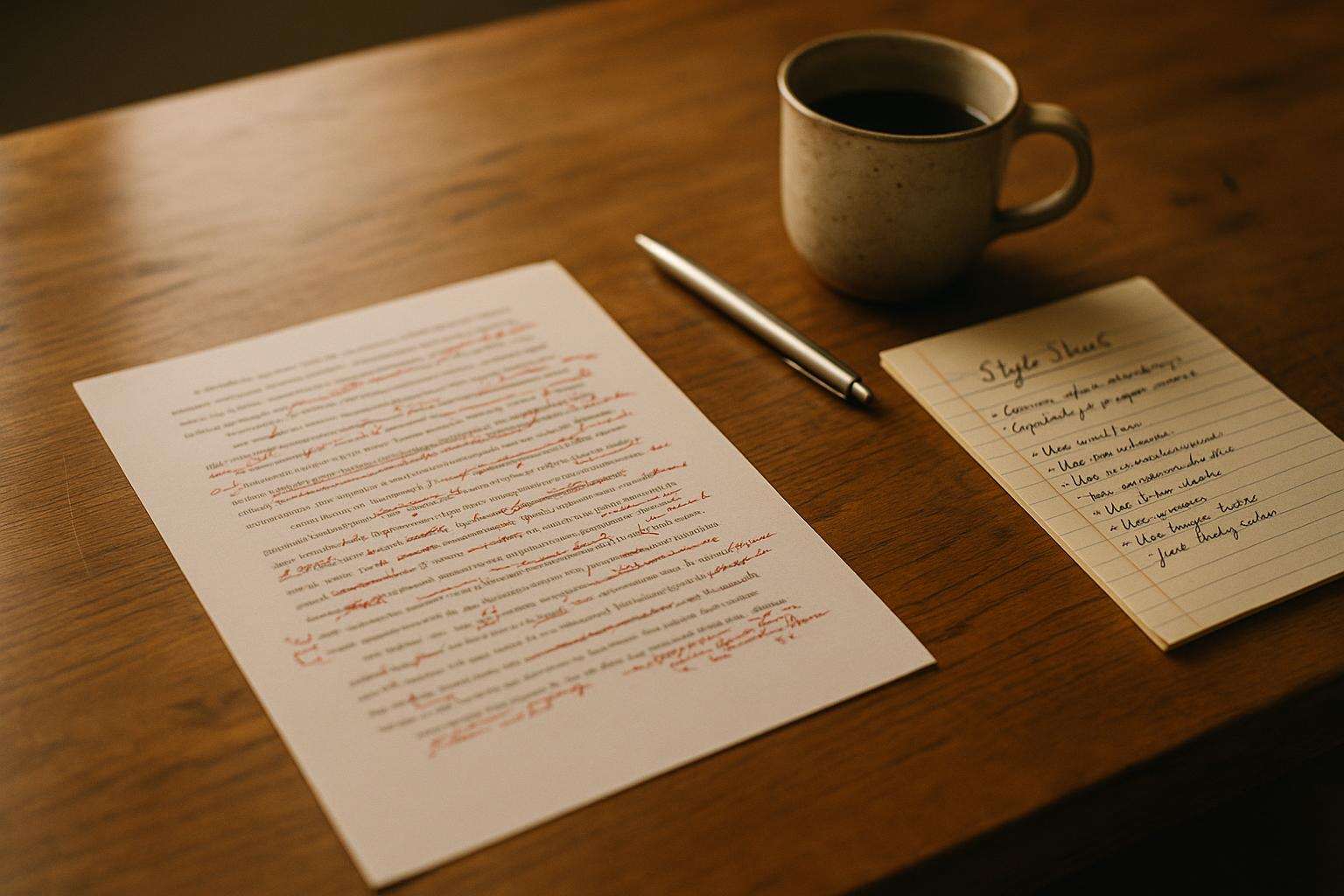
Most first-time indie authors treat editing as one long sweep through the draft — plot holes, clunky paragraphs, comma splices, and typos hunted in whatever order they surface. It feels efficient. It is actually the most expensive way to work. Professional publishing runs editing as a strict sequence of four distinct stages, each solving a different class of problem, and doing them out of order means paying to polish prose you later delete.
The stakes are not abstract. Grammar and editing errors are the single most common cause of negative reviews for independently published titles — not the plot, not the premise, the surface layer that most writers treat as cleanup and most readers treat as evidence of care.1 Getting this sequence right — and spending the right amount at the right stages — is the quality decision that protects everything else the book earns.
What Does Each Editing Stage Actually Do?
The four-stage professional pipeline runs from the largest structural problems to the smallest surface errors. Each stage must complete before the next one begins, because structural changes invalidate downstream surface edits every time.2
| Stage | What it solves | Reedsy 2025 rate (avg) | 80k-word cost estimate |
|---|---|---|---|
| Developmental editing | Structure, arc, pacing, argument — does the book work at the macro level? | ~$0.036/word | $2,080–$4,240 |
| Line editing | Paragraph rhythm, clarity, word choice — not correctness but quality | $0.027–$0.035/word (EFA 2025) | $2,160–$2,800 |
| Copy editing | Grammar, punctuation, consistency, usage, style sheet | ~$0.027/word | $1,520–$2,480 |
| Proofreading | Final sweep on the laid-out file — catches typesetting errors | ~$0.020/word | $960–$1,920 |
Rates are Reedsy 2025 marketplace averages and EFA 2025 per-word ranges.3,4 A full pipeline on an 80,000-word novel at Reedsy mid-market prices runs approximately $4,560–$8,640 total. Budget-tier alternatives (vetted freelancers outside major marketplaces) run roughly $3,600–$5,200; premium tiers reach $14,400–$21,200.
One stage requires a special note: proofreading must happen after layout, not before it. Typesetting introduces its own category of errors — broken hyphenations, a word dropped at a line break, inconsistent chapter headers — and a proofread done on the pre-layout manuscript misses precisely the errors the reader actually encounters.5
Why Does the Sequence of Editing Stages Matter?
The sequence is not a stylistic preference — it is a cost principle. Complete the structural pass before the surface pass, or pay for the same sentences twice. If your developmental editor recommends cutting two chapters — a common outcome — every comma you fixed in those chapters was wasted budget. Structural changes invalidate surface edits every time.
The practical damage from skipping developmental editing is measurable: 68% of authors who skipped the developmental stage ended up requiring multiple rounds of copy editing, generating higher total costs than if they had done the structural work first, and producing a weaker manuscript at the end of it.2
Two stages may be scoped together with explicit prior agreement: line editing and copy editing can be combined in a single pass when the editor and author align on that scope upfront — it is the most common professional indie compromise. What must never be combined is developmental and copy editing. Judging whether a scene should exist at all and fixing its commas are fundamentally incompatible modes of attention. Attempting both simultaneously produces shallow structural treatment and lavished attention on prose that may be deleted.5
One discipline runs through the entire sequence: the style sheet. From the first copy-editing pass forward, maintain a living document recording every decision the manuscript makes — character and place name spellings, invented terms, your number policy, capitalization choices, hyphenation rules, Oxford comma or not. Pass it to the proofreader. In a series, reuse it across every title so the world stays internally consistent across thousands of pages.
The minimum viable editing pipeline for a self-published novel is professional copy editing plus professional proofreading. That is the floor below which review risk climbs sharply. If budget forces a single choice, protect the developmental edit first — structure cannot be fixed with a corrected file upload after launch, but surface errors can be corrected forever.
What Should You Spend on Professional Editing?
Editing spend correlates with income, but not in a straight line — and the shape of that correlation is the most practical finding in the business for authors making a budget decision right now.
The Written Word Media 2024 Indie Author Survey (more than 1,300 respondents) found that the investment range most strongly associated with upward income mobility sits at $250 to $999 per manuscript.6 Authors spending nothing on editing cluster overwhelmingly in the sub-$100-per-month income bracket, and the same survey data links $0 editing spend to the highest one-to-three-star review accumulation. That is a durable signal: some professional editing beats none by a wide margin.
But the correlation is not a straight ramp, and this is the part most editing-investment conversations skip. Authors spending $2,000 or more on editing did not show proportionally better income outcomes than the $250–$999 cohort — particularly when that higher spend went unaccompanied by cover investment, metadata optimization, or launch infrastructure.6 A flawless manuscript inside a cover that fails to signal its genre at thumbnail size, with no audience and no launch behind it, is a beautifully edited file that no one finds. Editing is necessary; it is not sufficient. The money has to be balanced across the whole publishing system.
For authors budgeting in the $250–$999 range on a full-length novel, the most strategic single purchase is typically a professional copy edit, preceded by the author's own structural self-edit passes and three to five genre-experienced beta readers for developmental feedback before the copy editor sees the manuscript. The developmental function does not disappear at this budget — it shifts partially to the author and the beta cohort, reducing the paid scope without sacrificing the structural integrity that protects launch reviews.
How Do Reedsy Rates Translate to a Real 80,000-Word Novel?
Reedsy's marketplace publishes 2025 average per-word rates based on actual project quotes through the platform. The numbers below apply these rates to an 80,000-word novel — the approximate median length for commercial fiction:
| Editing stage | Reedsy 2025 avg rate | 80k-word cost range |
|---|---|---|
| Developmental editing | ~$0.036/word | $2,080–$4,240 |
| Copy editing | ~$0.027/word | $1,520–$2,480 |
| Proofreading | ~$0.020/word | $960–$1,920 |
| Full pipeline (dev + copy + proof) | — | $4,560–$8,640 |
Source: Reedsy editing cost guide, 2025 marketplace data.3 The EFA 2025 rate chart shows a comparable fiction range: proofreading at 1.2¢–2.0¢ per word, copy editing at 2.0¢–2.7¢, line editing at 2.7¢–3.5¢, and developmental editing at 3.0¢–3.5¢ per word.4 Nonfiction editing commands a 10–20% premium at equivalent word counts, because editors are expected to fact-check claims and verify citations.
Several caveats apply to any rate table. Reedsy takes a 10% commission from both the editor and the author, so marketplace prices reflect that overhead. Rush premiums run 25–50% above standard rates — booking an editor at least four to six months in advance is itself a budget decision.2 And editorial assessments — a high-level feedback letter without in-manuscript markup — cost roughly one-third to one-half the price of a full developmental edit ($600–$1,500 for an 80,000-word manuscript versus $2,000–$4,000+ for a full developmental edit), and can serve as a cost-effective first diagnostic pass on structure before committing to the heavier investment.7
What Quality Threshold Separates a Recommendation from a Refund?
The consequences of under-editing are measurable at the platform level. Amazon KDP operates a formal quality-issue system with three consequence tiers: distracting issues generate a visible product-page quality warning label once approximately eight or more reader-reported errors accumulate on a single title; destructive issues trigger removal from sale when excessive; and critical issues — such as a book uploaded as an image scan or promotional content placed before the main text — trigger immediate removal from sale.8 A visible warning label on the product detail page kills conversion before a potential reader reaches the description or the sample.9
Reader tolerance data is equally precise. Community surveys converge on a tolerance threshold of roughly two visible typos: readers report forgiving a couple, but more than two actively noticed errors cause confidence to collapse and the review to turn negative.10 The professional target — the level below which most readers cannot consciously detect errors during normal reading — is fewer than three typos per ten thousand words.11 One error per page is what editors describe as an extremely high error rate, well above any professional standard.11
The science explains why one professional pass is never enough. Research by Dr. Ray Panko (University of Hawaii) found that professional proofreaders catch at most 95% of errors under lab conditions — and average only 81% on non-word errors and 66% on actual word errors in practice.12 A manuscript with 3,000 errors could retain approximately 150 uncorrected ones after a single professional proofread. This is why the most professionally produced indie books layer ARC readers as a final human safety net: genre readers tasked with flagging surviving typos four to eight weeks before launch, while simultaneously generating the launch-day reviews that promotional platforms require — many mandate a minimum of ten or more reviews before featuring a title.13
The full pre-launch editorial sequence a professionally finished manuscript moves through: a minimum two-week cooling-off period, then a full read-aloud pass (the ear catches dropped words and rhythm breaks the eye autocorrects); a structural self-edit that targets plot holes and pacing before any sentence-level polish; a paid 10–15-page sample edit to vet genre fit and communication style before contracting; the full editing pipeline in strict sequence; and the ARC safety net on the final formatted file. Every layer catches categories of errors the prior layer misses — and each skipped layer is an error category that reaches the reader.
Frequently asked
What are the four stages of professional book editing and what does each one do?
The four stages are developmental editing, line editing, copy editing, and proofreading, and they must run in that order. Developmental editing addresses the biggest structural problems: does the plot hold, does the argument deliver its promise, does the middle sag? Line editing works at the paragraph and sentence level — rhythm, word choice, and prose quality. Copy editing handles correctness: grammar, punctuation, consistency, and building the style sheet that governs the whole manuscript. Proofreading is the final sweep on the laid-out file, after typesetting, to catch errors that formatting introduced. Combining developmental and copy editing in a single pass is a professional error because the two stages require incompatible modes of attention. Line and copy editing may be scoped together with prior agreement between editor and author.
What does the Written Word Media survey say about the ideal editing spend for indie authors?
The Written Word Media 2024 Indie Author Survey (more than 1,300 respondents) found that the investment range most strongly associated with upward income mobility is $250 to $999 per manuscript. Authors spending $0 on editing clustered in the lowest income bracket and showed the highest rates of negative reviews citing quality failures. Authors spending $2,000 or more on editing did not show proportionally better income outcomes than the $250–$999 cohort — particularly when cover and metadata investment was absent. The finding is directional, not a guarantee, but it is the most grounded public benchmark for where editing investment pays off relative to the rest of the publishing system. Treat it as a signal about balance, not a price floor or ceiling.
How much does a developmental edit cost for an 80,000-word novel?
Based on Reedsy's 2025 marketplace averages, a developmental edit on an 80,000-word novel runs approximately $2,080 to $4,240, at a blended rate of around $0.036 per word. The EFA's 2025 rate chart places developmental editing for fiction at 3.0¢–3.5¢ per word. Nonfiction developmental editing commands a 10–20% premium at the same word count because editors are expected to fact-check claims and verify citations. Authors with tighter budgets can substitute an editorial assessment — a high-level feedback letter without in-manuscript markup — for approximately one-third to one-half the cost: roughly $600–$1,500 for an 80,000-word manuscript versus $2,000–$4,000 or more for a full developmental edit. Book editors at least four to six months in advance; rush premiums run 25–50% above standard rates.
At what error rate does Amazon KDP issue a quality warning on an ebook?
Amazon KDP's quality system has three consequence tiers. Distracting issues — the most common category, covering typos and formatting inconsistencies — accumulate on the title's Quality Notifications dashboard. Once approximately eight or more individual reader-reported quality items accumulate on a single title, KDP triggers a visible quality warning label on the product detail page, which directly suppresses conversion. Destructive issues (errors that prevent comprehension) trigger removal from sale when excessive. Critical issues — such as a book uploaded entirely as scanned images, or promotional bonus content placed before the primary text — trigger immediate removal. KDP sends a weekly Kindle Quality Notice email to the author's account when new items are flagged, so monitoring the dashboard weekly is the practical defense against a warning label accumulating unnoticed.
Why does proofreading need to happen after layout and not before?
Typesetting introduces a distinct class of errors that do not exist in the pre-layout manuscript: broken hyphenations at line breaks, words dropped at page turns, inconsistent chapter header formatting, and orphaned lines. A proofread performed on the pre-layout Word document or Scrivener file cannot catch these errors because they do not yet exist. By the time the reader opens the book, the formatted file is the only version that matters — so the proofread must happen on the formatted file, not on the draft the author submitted to the editor. This is why many authors use the free Reedsy Book Editor to produce their final ePub, Mobi, and print PDF before the final proofread pass: it standardizes the typesetting so the proofreader reviews the exact file the reader will receive.
Is Grammarly or ProWritingAid sufficient for self-publishing quality control?
Automated grammar tools are not a substitute for professional editing, and treating them as such is one of the most documented anti-patterns in indie publishing. Grammarly and ProWritingAid catch a subset of surface-level errors — certain comma placement issues, repeated words, some passive voice — but they cannot flag plot inconsistencies, character continuity errors, structural sag, or genre-obligation failures. These are exactly the failures that generate one-star reviews. Research by Dr. Ray Panko found that even professional human proofreaders miss up to 34% of word errors under normal conditions; automated tools miss far more of the categories that matter most. Use these tools as a first self-edit pass to clear obvious surface issues before submitting to a professional editor — not as a replacement for one.
What is the reader tolerance threshold for typos in a self-published book?
Community surveys and reader feedback channels converge on a tolerance threshold of roughly two actively noticed typos: readers report forgiving a couple of errors, but more than two visible mistakes cause confidence to collapse and the review to turn negative. The professional target is fewer than three typos per ten thousand words — the error density below which most readers cannot consciously detect errors during normal reading flow. One typo per page is what editors classify as an extremely high error rate. These thresholds explain why a single professional proofreading pass is typically insufficient: Dr. Ray Panko's research found professional proofreaders average only 66% catch rates on word errors, meaning a manuscript with 3,000 errors could retain around 1,000 uncorrected ones after a single pass. Multiple sequential editors and ARC readers provide the compounding coverage the math requires.